The world seems to be full today of Christians, some well meaning, and some obvious charlatans, who make their livings in the field of Christian Apologetics. For reference, let’s look at the definition of “apologetics”. From Merriam-Webster online dictionary:
1: systematic argumentative discourse … in defense (as of a doctrine)
2: a branch of theology devoted to the defense of the divine origin and authority of Christianity
So for the purposes of this discussion, apologetics collectively offers a series of arguments for the existence of god, for the truth of the Christian religion, and for various specific matters of theology. As with any logical argument, they must be evaluated based on:
Whether the premises of the argument are valid. As an example, if an argument starts with the premise that all men are stronger than all women, it may be disproved by identifying even a single example of a woman who is stronger than at least one man.
Whether the logic of the argument is valid. Independently of whether the premises are true, the logic of the argument must support the conclusion based on the premises. As an example, if we say that there is a correlation between A and B (the premise), therefore A causes B, the argument is faulty, because correlation does not imply causation.
These (Un)Apologetics are my attempt to answer the apologists’ arguments. My arguments are (in most cases) neither new, nor unique, but rather are just a composite of (in some cases) my own reactions, and in many other cases, information I’ve learned since my deconversion. I shall try to credit others when possible/appropriate.
As a general observation, one must wonder if the apologists really believe in the validity of their own arguments. They have a multiplicity of supposed “proofs” for the existence of god. But if any one of those arguments was sufficiently rigorous, there would be no need for any others.
But in spite of all the existing “proofs” for god, numerous apologists continue to spend their careers developing and refining new ones. And that’s because none of the arguments, whether old or new, actually stand up to any real scrutiny. They are all just different exercises in sophistry, appealing to those who are predisposed to theism, but failing on one or more factual or logical grounds.
The Christian faith is fundamentally incoherent. The reason is simple.
1. God is described as omnibenevolent – perfectly good, loving, just, and merciful.
2. Purportedly, God created humanity with the overarching command that we worship him. According to most (not all) Christians, those who fail to do so (or who simply disbelieve) are punished for all eternity. Eternal punishment for the sin of mere disbelief is neither loving, nor just, nor merciful. Even if one rejects the concept of hell as a place of eternal torment, the Bible itself (especially the Old Testament) describes a God who is anything but good. Refer to my post: “God is Not Good.”
3. Because 1 and 2 are contradictory, the Christians’ own description of their God’s nature is fundamentally incoherent, and therefore Christianity itself is incoherent.
The essence of the pro-life argument against abortion is their belief that “life begins at conception”. They declare that this isn’t just their opinion; science itself says so. They claim that biologists are in broad agreement on this fact. And if we’re simply talking about the organism itself, they’re 100% correct. When an egg is fertilized, and becomes a zygote, it is unquestionably a new life – one that (if all goes well for it) will eventually develop into a living, breathing person.
So, since the zygote is alive, and since we’re talking about human zygotes, they reason that the zygote is a human life, and that abortion is therefore the intentional taking of a human life (i.e. murder).
But this argument pretends that there is no significant qualitative difference between the “humanity” of the zygote, and that of a living, breathing person, when in fact, the differences are enormous and profound. So the more critical question is whether the zygote is truly a “person”. That’s a question that science alone can’t answer, because determining what truly defines a person, is a philosophical, not a scientific question. Science can only describe the qualities and nature of a zygote (or embryo or fetus).
Pro-lifers will argue that our humanity/personhood is defined by our DNA. Our DNA IS different from all other species, but some fairly significant mutations can occur, and the person is still considered to be human. But at conception, the function of DNA is to manage the workings of the cell, but more significantly, it provides the instructions that will cause this cell to eventually develop into a baby. The DNA is not the person, it’s the instructions for creating the person.
Humans are complex beings, with numerous traits that distinguish us from other animal species. Many, of course, are physical traits. Our bodies have a variety of features that are obviously different from even our closest related species, but those physical traits don’t define our personhood. We could lose all our limbs, and have numerous internal organs transplanted (sometimes with animal parts) or have organs replaced with mechanical substitutes, and few, if any, would argue that we are no longer persons.
Carrying that to the extreme, there is only one feature that is inextricably linked to our personhood – our minds. If a person suffered severe trauma, such that most of the body could not survive, but we could transplant their brain into a machine which could keep it alive, allowing it to interact with the outside world, that PERSON would still be alive. Conversely, we already have numerous examples today in which a person may lose all brain function, with their body otherwise unharmed. We can keep that body alive through the use of machines, but unless there is some reasonable hope of recovery, we don’t. Instead, we decide that their human lives have effectively ended, and we unplug them.
A person is the sum total of their experiences, memories, personality, intelligence, emotions, values, etc. When someone loses all brain function, those things are lost with it. The “person” is gone.
I’ll note that this is not the case for someone who is unconscious or in a temporary vegetative state. They may no longer be aware of their environment, potentially being temporarily non-sentient. But in this case, the “person” still exists within the unresponsive brain.
So if personhood ends with the loss of the mind, it follows that personhood doesn’t begin until the mind exists. So when does that happen? Unfortunately there is no black and white answer to that. On one extreme, the zygote clearly has no mind. On the other extreme, a newborn baby clearly DOES have one, as evidenced by (among other things) the fact that it’s capable of learning.
The fetal brain begins to develop at about 3 weeks, with the first neurons forming. At 5 weeks, a neural tube has formed. Electrical activity in the brain begins at about 8 weeks, which begin to initiate involuntary muscle movements in the womb. By 10 weeks, there is a recognizable brain structure, but it’s smooth, without the characteristic folds of a fully-formed brain. The fetus still has no cerebral cortex, and is non-sentient (i.e. unaware of either itself or its environment). While it may respond to external stimuli, the reactions are purely reflexive. It can feel no pain.
The onset of sentience occurs around 24 weeks. It is only then, that the fetus begins to become AWARE of external stimuli, including feeling pain, etc. But while the fetus is sentient, it is not yet sapient. It can feel, but it cannot think. It has no memories, no emotions, no personality, etc. It is still not yet a “person”. For that, the fetus requires not only sentience, but some degree of sapience.
And this is where things become VERY gray. Gradually over about the next 16 weeks, the fetus evolves from being merely sentient to becoming sapient. That evolution continues after birth, and in fact, the brain takes decades to fully mature. There is no single moment that defines the transition to sapience. Therefore there is no clear-cut moment at which we can say that the fetus’ human life (aka its personhood) has begun. But we know it’s not before about 24 weeks,
In my discussions with abortion opponents, they will commonly argue that these aren’t the same. If someone is in a persistent vegetative state, and it’s determined that there is little to no hope of recovery, that’s entirely different from the fetus, which has a pretty good chance of becoming a fully functioning person. While that’s true, that doesn’t change the fact that the early term fetus is NOT YET a person. Terminating the pregnancy does not kill a person, just as terminating life support for one who is brain dead, does not kill a person (that person is already gone).
Between the 1973 Roe v Wade and the 2022 Dobbs v. Jackson Women’s Health Organization decisions, the various states allowed unrestricted abortions until around 24 weeks (give or take, depending on the state), with later exceptions for severe fetal abnormalities, or to protect the life/health of the woman. The 24 week threshold is not entirely a coincidence. Those laws have typically been based on fetal viability, but it’s not surprising that fetal viability would be correlated in part to brain development. While advances in medical technology will likely continue to improve the viability for younger (earlier-term) fetuses, these are unlikely to accelerate the onset of sentience.
But given those laws, my perception is that they gave plenty of time in the overwhelming majority of cases, for women to become aware of a pregnancy, to decide if they wanted to carry it to term, and to get an abortion if not.
At the risk of inviting the “no uterus, no opinion” reactions from women, I personally think those laws were pretty good, and I’m uncomfortable with suggestions that abortion ought to be completely unrestricted, because I agree with abortion opponents, that the personhood status (from a philosophical and scientific perspective) isn’t materially changed when a baby leaves the womb and takes its first breath. (Though obviously the LEGAL personhood status DOES change at that moment).
A primary argument from many pro-choicers, is the right of women to bodily autonomy. I absolutely agree with it, but I think the argument becomes weaker as the pregnancy continues. The woman has that right, but early in the pregnancy there is, as yet, no “person” in the womb that could have any competing rights. Late in pregnancy, however, that’s not the case. At that point, there are valid ethical questions as to whether bodily autonomy should take precedence over protecting the life of a sentient being.
I draw an analogy to a situation in which I’m holding onto someone to prevent them from falling off a cliff. At that moment, the other person is completely dependent on me for their survival. But do I have an obligation to give up my own autonomy, and continue holding them? If I can do so without risking my own safety, most people would agree that it would be unethical to let that person fall to their death.
It’s really not much different than if one is driving along, and a person walks in front of your vehicle. Even though you have the legal right of way, you also have a legal obligation to attempt to avoid hitting that person, IF you can do so without significantly endangering yourself or others.
These competing interests were overtly recognized in the Roe decision, and resulted in laws that adopted a reasonable balance between those interests. Since the Dobbs decision, many states have abandoned that balance, and rejected any notion of a right to bodily autonomy, while absurdly granting rights to a single cell.
It is my opinion that we need to restore the balance that was established by Roe. I believe that women should have an unrestricted right to abortion for about the first 24 weeks, with later exceptions for cases of severe fetal abnormality, and to protect the life and health of the woman. The approximate 24 week threshold is not based on viability considerations, but rather the criterion of sentience discussed above.
I do not support unrestricted abortions throughout pregnancy. And for what it’s worth, I believe that those who push for this are hurting the greater cause, by shifting the debate to that extreme position, rather than focusing energy on the more moderate position that has pretty widespread support. I see little chance that pro-lifers will be persuaded by any argument that denies personhood considerations for late term fetuses, or declares that those considerations are completely irrelevant in the face of rights to bodily autonomy.
William Lane Craig is well known as a purveyor of sophistry. I only recently came across his bizarre and reprehensible take on the ancient Jews’ campaign of genocide against the Canaanites, as detailed in the Old Testament.
From Craig:
“So whom does God wrong in commanding the destruction of the Canaanites? Not the Canaanite adults, for they were corrupt and deserving of judgment. Not the children, for they inherit eternal life. So who is wronged? Ironically, I think the most difficult part of this whole debate is the apparent wrong done to the Israeli soldiers themselves. Can you imagine what it would be like to have to break into some house and kill a terrified woman and her children? The brutalising effect on these Israeli soldiers is disturbing.”
With this one repugnant statement, Craig (a snake oil salesman who has the nerve to lecture nonbelievers on matters of morality) instantaneously obliterated any pretense of holding the moral high ground.
The full text of Craig’s contemptible article may be seen here:
Christian apologists will frequently argue that the Criterion of Embarrassment adds credence to the Bible. The argument is essentially claiming that any stories which cast a protagonist in any sort of unfavorable light, are less likely to be fabrications. A couple of commonly cited examples include Peter’s denial of Jesus and the fact that the first reported witnesses to the resurrection were women (who were considered less credible than men).
The former example is a poor one for the simple reason that Christian theology is built on the teaching that humans are imperfect and weak. If Peter was portrayed in a consistently flawless manner, it would undermine the entire theology.
The latter example might be valid if it weren’t for the addition of other supposed resurrection confirmations by men.
The Problem
What apologists ignore is the fact that their beloved criterion is a double edged sword. If the embarrassment criterion lends credibility to certain passages, its reverse should likewise induce considerable skepticism. By definition, if supposedly embarrassing stories somehow add credibility, positive stories (especially ones that are fantastic in nature) written by members of the early Jesus cult should be inherently and significantly suspect. So the flip-side corollary to the Criterion of Embarrassment, is the Criterion of Embellishment. In today’s vernacular, if it sounds too good to be true, it probably is. Hence the claims of miracles, and the resurrection itself SHOULD engender significant skepticism among Christians.
Christianity is certainly not the only religion whose sacred text tells some truly tall tales. And commonly, adherents of each religion will argue that THEIR fantastic tales are credible, while those of other religions are fabrications. Everyone believes that:
My religion is logical and true.
Every other religion is false, if not downright silly.
So for EVERY world religion, a small minority of the world population believes it’s logical and true, while a strong majority of the world’s population believes it’s false, if not downright silly. What they all have in common is a healthy skepticism and critical thinking regarding other religions. They instinctively apply the criterion of embellishment to other religions, while holding their own religion to an entirely different standard, with a VERY low bar for standards of credibility.
The Argument from Fine Tuning comes in a variety of forms, each making the claim that various features of our planet, our solar system, the universe (including a variety of physical constants) exist within an extremely narrow range of values that allow life to exist. They argue that these are each individually unlikely, and are virtually impossible collectively unless they have been intentionally fine tuned.
Some of the arguments are obviously absurd. One example is the fact that the Earth is located within the ”Goldilocks zone” in terms of its distance from the sun. If we were significantly nearer or farther from the sun, life as we know it would not be possible on Earth.
But when one considers the fact the universe has an estimated trillion trillion stars, most of them probably having multiple planets, there are likely many trillions of planets within their respective star’s Goldilocks zones. We’re here in part, because Earth just happens to be one of them.
Most of the other arguments involve discussions of some pretty advanced Physics. Very few of the proponents of the Fine Tuning Argument have any Physics education whatsoever. So they don’t actually understand the argument at all. They’re not equipped to evaluate it critically, so it sounds compelling, and, of course, it suits their agenda.
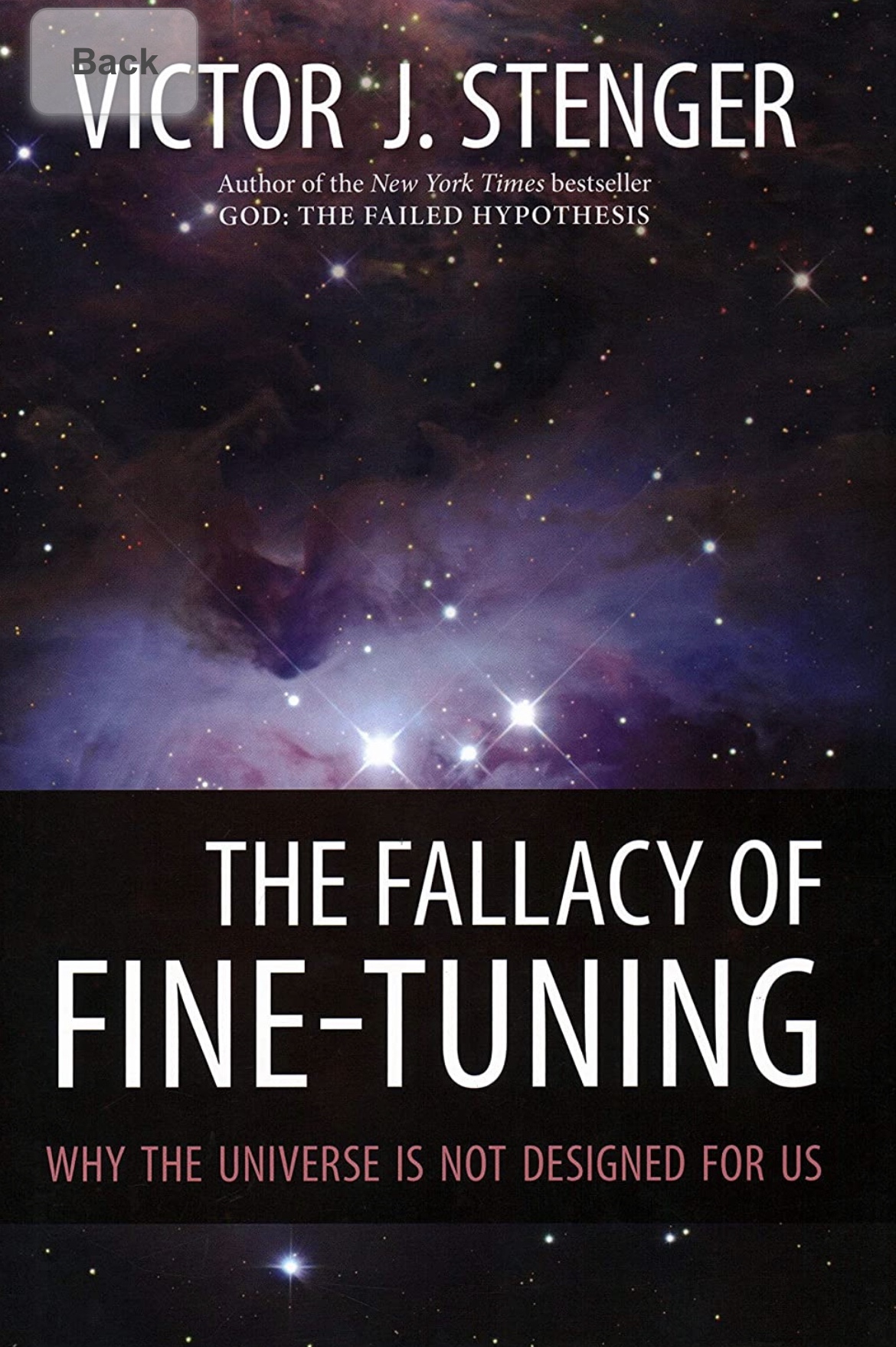
And while I have a BS in Physics, that degree (and the fact that it was several decades ago) doesn’t qualify me to address most of those arguments either. Fortunately I don’t have to. Qualified physicists have already done a pretty thorough job of refuting it. I recommend Victor J. Stenger’s ‘The Fallacy of Fine-Tuning’, which addresses each of the supposedly fine-tuned parameters, and shows that either the parameter could not have had any other value, or that the parameter could have varied far more than the Fine Tuning Argument claims, while still allowing for life in the universe.
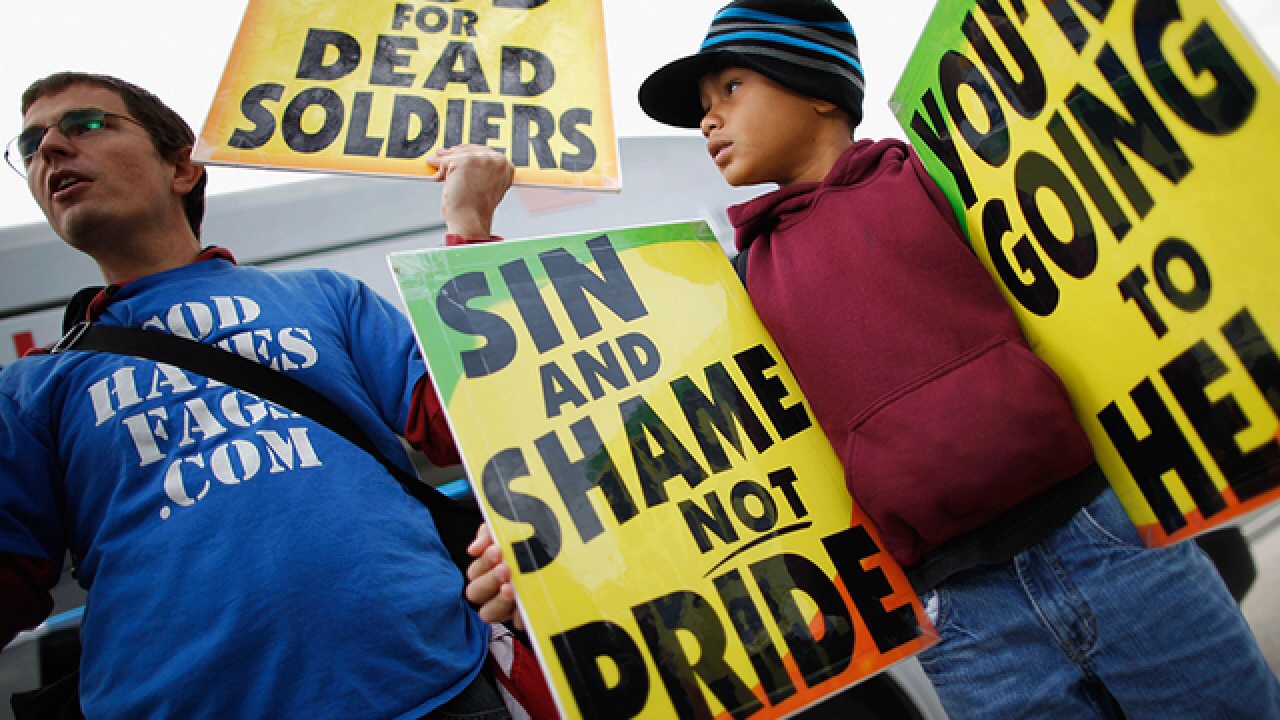
In response to criticisms by atheists, theists frequently ask the question, ”Why do atheists care?” This is often supplemented with ”Why do atheists spend so much time attacking a god in whom they say they don’t believe?” Some further express the opinion that either we hate god, or we’re just trying to convince ourselves of our disbelief. Those opinions are, of course, logical fallacies (attacking the motives).
I won’t presume to speak for all atheists, but for many of us, the answer to the question of why we care is simple. We care because of theists’ incessant efforts to:
Install their icons in our public spaces
Teach their mythology in our science classes
Push prayer in our public schools and government meetings
Discriminate against others based on narrow-minded prejudice (cloaked always in sanctimony)
Set public policy based on the musings of ancient men.
And for many, transform our nation into a theocracy
The moment theists cease these efforts, is the moment I stop caring.
Here’s a new gospel, given to me by the one true god.
1. You humans have finally developed enough for me to reveal myself to you.
2. I’m actually not the only god. There are lots of others like me, but they have absolutely no involvement in your universe.
3. All the thousands of other gods worshiped now and throughout human history are false, being nothing more than human inventions.
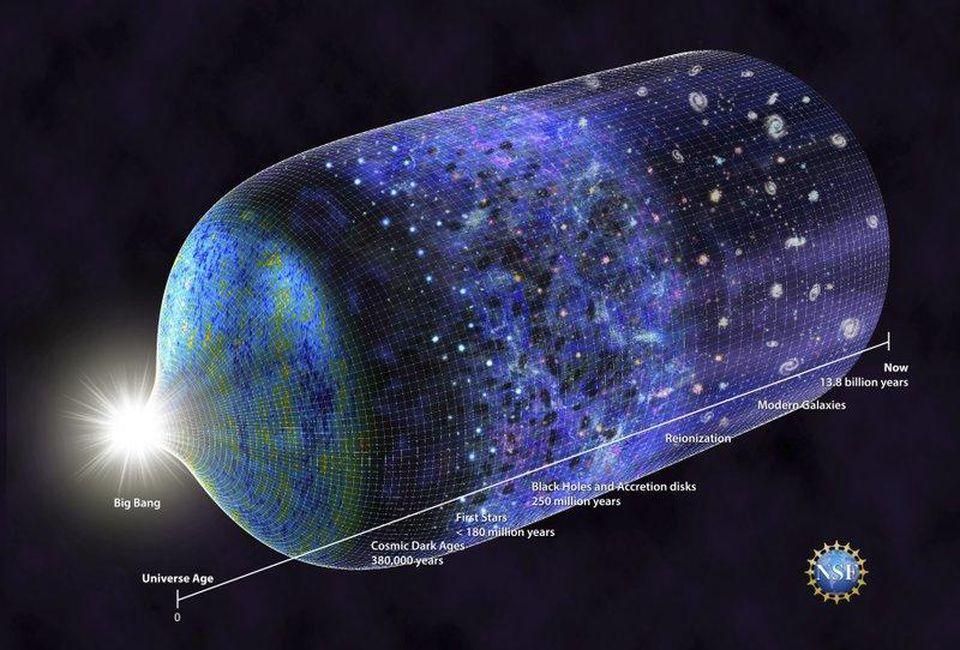
4. I caused the Big Bang about 14 billion years ago, and then left things totally alone to happen as they may, according to the natural laws of the universe. I know a lot of you want to know how I did it, but I’m not going to tell you. You’ll probably figure it out eventually.
5. Life began autonomously on earth, and on millions of other planets throughout the cosmos. The origination of life on any given planet is pretty unlikely, but I made the universe big enough, (with over a trillion trillion planets so far), that the development of life on numerous planets was a statistical certainty. Earth just happens to be one of them, due to nothing more than random luck.
6. Once life began, it evolved naturally into the wide diversity and complexity you have today… and that includes humanity.
7. Mankind is not the culmination of all of creation. You’re really nothing special. There are far more advanced (and better behaved) species on other planets. And over the coming billions of years, the humanity of today’s earth will be forgotten, having long since evolved into various species that you can’t even imagine today.
8. There’s no afterlife for mankind. You live for a while, and then you’ll die. Period. But don’t get upset about it – Nothing is forever … well, except for me.
9. I don’t care what individual humans do with their lives. Every person has to figure that out for themselves. But I’ll offer just a few words of friendly advice, which you can take or leave as each of you sees fit:
A. Try to enjoy your life for the short time you’re on earth.
B. Don’t look to me for your purpose. Like I said, I don’t really care. Each of you has the freedom to decide your own purpose and meaning.
C. Try to help other humans when and where you can. For better or worse, you’re all in the same boat.
D. You don’t need religion. As I said, none of your gods are real. I am, but I have no need or desire to be worshipped. And there’s nothing in it for you anyway. I’m not going to intervene in your lives, I don’t want to be your friend, and (as I also said) there’s no afterlife.
E. Stop acting like your national boundaries are a big deal. You’ll all be a lot happier when you realize that you are one people and one planet.
F. Take care of your planet. It’s the only one you’ve got (so far) and you won’t survive if you turn it into a wasteland.
The Ontological Argument for God was first advanced by Saint Anselm, who was the Archbishop of Canterbury from 1033 to 1109. in the Proslogium:
[Even a] fool, when he hears of … a being than which nothing greater can be conceived … understands what he hears, and what he understands is in his understanding.… And assuredly that, than which nothing greater can be conceived, cannot exist in the understanding alone. For suppose it exists in the understanding alone: then it can be conceived to exist in reality; which is greater.… Therefore, if that, than which nothing greater can be conceived, exists in the understanding alone, the very being, than which nothing greater can be conceived, is one, than which a greater can be conceived. But obviously this is impossible. Hence, there is no doubt that there exists a being, than which nothing greater can be conceived, and it exists both in the understanding and in reality.
In standard logical form, this can be written as:
God is defined as a being of which none greater can be imagined (that is, the greatest possible being that can be imagined).
God exists as an idea in the mind.
A being that exists as an idea in the mind and in reality is, other things being equal, greater than a being that exists only as an idea in the mind.
Thus, if God exists only as an idea in the mind, then we can imagine something that is greater than God (that is, a greatest possible being that does exist).
But we cannot imagine something that is greater than God (for it is a contradiction to suppose that we can imagine a being greater than the greatest possible being that can be imagined.)
Therefore, God exists
It didn’t take long for Anselm’s argument to attract criticism. Gaunilo of Marmoutier raised the objection that one could use Anselm’s argument to show the existence of all kinds of non-existent things. Gaunilo substituted “island” for “being” as an example:
Now if some one should tell me that there is … an island [than which none greater can be conceived], I should easily understand his words, in which there is no difficulty. But suppose that he went on to say, as if by a logical inference: “You can no longer doubt that this island which is more excellent than all lands exists somewhere, since you have no doubt that it is in your understanding. And since it is more excellent not to be in the understanding alone, but to exist both in the understanding and in reality, for this reason it must exist. For if it does not exist, any land which really exists will be more excellent than it; and so the island understood by you to be more excellent will not be more excellent.”
Gaunilo had the right idea, but chose a poor example, as one can argue that it is impossible to conceive of a perfect island, since the opinions about perfection of an island are subjective (as in the ideal temperature) and even within any one person’s vision of the perfect island, one could propose additional (qualitative or quantitative) features, that might make it even better. Conversely, the Christian God is purported to be all-powerful, all-knowing, all-wise, perfectly just, etc. Some of these traits, such as omnscience, cannot, by definition, be improved upon. It is impossible to conceive of a being knowing more than everything. Other traits, such as “perfectly just” might be arguable on the basis that, like the perfect temperature on an island, it is subjective, because people often disagree on matters of justice. But the simple response to that argument is that human opinions on justice should not be confused with some absolute standard of justice. I think this is a valid position for the purposes of the Ontological Argument, though it has issues in other apologetics arguments, which utilize the circular argument that God’s justice is perfect because he’s God.
So given that Gaunilo’s analogy failed because of the subjective nature of the perfect island, we can easily substitute some other object, which is not subjectively defined. We could postulate a “perfect 1 meter gold sphere”. This hypothetical object would be 100% solid gold, with no impurities, would be EXACTLY 1 meter in diameter, and would be perfectly spherical (to a resolution down to the atomic level). Per Anselm’s logic, the “perfect 1 meter gold sphere” MUST exist in reality, since an imaginary “perfect 1 meter gold sphere” would be inferior to a real one, and hence would be imperfect. And of course, the 1 meter size was an arbitrary choice. We could just as easily postulate a 1 billion km diameter perfect gold sphere. Neither perfect gold spheres nor gods can simply be imagined into existence.
Immanuel Kant (1724-1804) explained the specific logical flaws in both Anselm’s and Descartes’ arguments. Kant attacks Anselm’s premise 3’s claim (that a being that exists as an idea in the mind and in reality is greater than a being that exists only as an idea in the mind). In The Critique of Pure Reason, Kant rejects premise 3 on the ground that existence does not function as a predicate (i.e. as a PROPERTY) of any object:
I should have a reasonable hope of putting an end for ever to this sophistical mode of argumentation, by a strict definition of the conception of existence, did not my own experience teach me that the illusion arising from our confounding a logical with a real predicate (a predicate which aids in the determination of a thing) resists almost all the endeavours of explanation and illustration. A logical predicate may be what you please, even the subject may be predicated of itself; for logic pays no regard to the content of a judgement. But the determination of a conception is a predicate, which adds to and enlarges the conception. It must not, therefore, be contained in the conception.
Being is evidently not a real predicate, that is, a conception of something which is added to the conception of some other thing. It is merely the positing of a thing, or of certain determinations in it. Logically, it is merely the copula of a judgement. The proposition, God is omnipotent, contains two conceptions, which have a certain object or content; the word is, is no additional predicate—it merely indicates the relation of the predicate to the subject. Now, if I take the subject (God) with all its predicates (omnipotence being one), and say: God is, or, There is a God, I add no new predicate to the conception of God, I merely posit or affirm the existence of the subject with all its predicates—I posit the object in relation to my conception. The content of both is the same; and there is no addition made to the conception, which expresses merely the possibility of the object, by my cogitating the object—in the expression, it is—as absolutely given or existing. Thus the real contains no more than the possible.
A hundred real dollars contain no more than a hundred possible dollars. For, as the latter indicate the conception, and the former the object, on the supposition that the content of the former was greater than that of the latter, my conception would not be an expression of the whole object, and would consequently be an inadequate conception of it. But in reckoning my wealth there may be said to be more in a hundred real dollars than in a hundred possible dollars—that is, in the mere conception of them. For the real object—the dollars—is not analytically contained in my conception, but forms a synthetical addition to my conception (which is merely a determination of my mental state), although this objective reality—this existence—apart from my conceptions, does not in the least degree increase the aforesaid hundred dollars.
By whatever and by whatever number of predicates—even to the complete determination of it—I may cogitate a thing, I do not in the least augment the object of my conception by the addition of the statement: This thing exists. Otherwise, not exactly the same, but something more than what was cogitated in my conception, would exist, and I could not affirm that the exact object of my conception had real existence. If I cogitate a thing as containing all modes of reality except one, the mode of reality which is absent is not added to the conception of the thing by the affirmation that the thing exists; on the contrary, the thing exists—if it exist at all—with the same defect as that cogitated in its conception; otherwise not that which was cogitated, but something different, exists. Now, if I cogitate a being as the highest reality, without defect or imperfection, the question still remains—whether this being exists or not? For, although no element is wanting in the possible real content of my conception, there is a defect in its relation to my mental state, that is, I am ignorant whether the cognition of the object indicated by the conception is possible á posteriori. And here the cause of the present difficulty becomes apparent. If the question regarded an object of sense merely, it would be impossible for me to confound the conception with the existence of a thing. For the conception merely enables me to cogitate an object as according with the general conditions of experience; while the existence of the object permits me to cogitate it as contained in the sphere of actual experience. At the same time, this connection with the world of experience does not in the least augment the conception, although a possible perception has been added to the experience of the mind. But if we cogitate existence by the pure category alone, it is not to be wondered at, that we should find ourselves unable to present any criterion sufficient to distinguish it from mere possibility.
Whatever be the content of our conception of an object, it is necessary to go beyond it, if we wish to predicate existence of the object. In the case of sensuous objects, this is attained by their connection according to empirical laws with some one of my perceptions; but there is no means of cognizing the existence of objects of pure thought, because it must be cognized completely á priori. But all our knowledge of existence (be it immediately by perception, or by inferences connecting some object with a perception) belongs entirely to the sphere of experience—which is in perfect unity with itself; and although an existence out of this sphere cannot be absolutely declared to be impossible, it is a hypothesis the truth of which we have no means of ascertaining.
René Descartes (1596-1650) had proposed a simpler version of the ontological argument:
Whatever I clearly and distinctly perceive to be contained in the idea of something is true of that thing.
I clearly and distinctly perceive that necessary existence is contained in the idea of God.
Therefore, God exists.
Descartes’ formulation clearly suffers from the same flaw as Anselm’s, in declaring existence to be a predicate in his conception of God.
Plantinga’s Argument
Alvin Plantinga reformulated the Ontological Argument, adding semantic devices that are designed to obscure the logical flaws. His version is as follows:.:
A being has maximal excellence in a given possible world W if and only if it is omnipotent, omniscient and wholly good in W; and
A being has maximal greatness if it has maximal excellence in every possible world.
It is possible that there is a being that has maximal greatness. (Premise)
Therefore, possibly, it is necessarily true that an omniscient, omnipotent, and perfectly good being exists.
Therefore, it is necessarily true that an omniscient, omnipotent and perfectly good being exists (axiom S5).
Therefore, an omniscient, omnipotent and perfectly good being exists.
Point 1 is a simple definition.
Point 2 makes essentially the same error as both Anselm and Descartes, by equating “Maximal Greatness” of a “maximally excellent” but otherwise hypothetical being as one that actually exists in every possible world. And this definition is already begging the question, by setting the criterion that a god can only be maximally great, if it is impossible for it to not exist.
Point 3 is identified as a Premise, and completes the act of begging the question. To rephrase it, he’s saying that it’s possible that a god exists in every possible world. Left unstated is the possibility that this being exists in no possible world, or only in some possible worlds. So points 2 and 3 stack the deck for the conclusion. He’s saying that it’s possible that every imaginable world has a god. That statement is obviously false, as we KNOW that we can imagine a world without god. Since this premise is false, his Ontological argument fails.
Gödel’s Argument
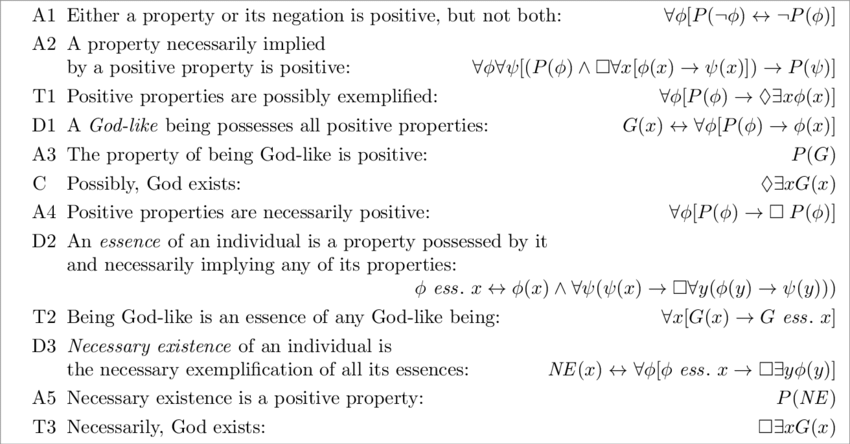
Kurt Gödel developed an updated form of Anselm’s original argument, using modal logic, shown here in its original mathematical notation.
Wikipedia provides a translation of this to standard English:
As noted, Gödel developed this as an update to Anselm’s argument, and he has not solved the key problem. Axiom 5 (“A5”) declares that necessary existence is a positive property. This is equivalent to Anselm’s claim that the greatest possible being that one can imagine (and who actually exists) is superior to the EXACT same being who does not exist. This notion was refuted earlier in the discussion of Anselm’s argument.
Craig’s Argument
William Lane Craig has an alternative form of Plantinga’s ontological argument:
It is possible that a maximally great being (God) exists.
If it is possible that a maximally great being exists, then a maximally great being exists in some possible world.
If a maximally great being exists in some possible world, then it exists in every possible world.
If a maximally great being exists in every possible world, then it exists in the actual world.
Therefore, a maximally great being exists in the actual world.
Craig defines the “possible worlds” term as follows: “To say that some entity exists in a possible world is just to say that such an entity possibly exists. It isn’t meant that the entity actually exists somewhere. Look again at my explanation: “To say that God exists in some possible world is just to say that there is a possible description of reality which includes the statement ‘God exists’ as part of that description.””
Note that Craig is using the “Maximally Great” terminology, which he defines as ” A maximally great being is one that has, among other properties, necessary existence. So if it exists in one world, it exists in all of them!”
So in premises 1 and 2, he inherently includes the criterion of existence in every possible world. But by starting out with that terminology, Craig’s first statement is already guilty of begging the question. He’s declaring that it’s possible that a god necessarily exists in every possible world (which he expressed later in step 3). Those statements are clearly false. We can obviously conceive of worlds in which no god exists, so it’s a gross error to state that it’s possible that every imaginable world has a god. Every statement after his first point is therefore moot. Craig’s argument is sophistry of the worst sort.
As a demonstration, let’s apply his logic to a being who is like God in every way, except that instead of being perfectly good, it is perfectly evil (Anti-God).
1. It is possible that a maximally evil being (Anti-God) exists.
2. If it is possible that a maximally evil being exists, then a maximally evil being exists in some possible world.
3. If a maximally evil being exists in some possible world, then it exists in every possible world.
4. If a maximally evil being exists in every possible world, then it exists in the actual world.
5. Therefore, a maximally evil being exists in the actual world.
6. Therefore, a maximally evil being exists.
7. Therefore, Anti-God exists.
I’ve offered this counter example to several theists, who (predictably) rejected it through the naked application of special pleading. They claim that the logic can ONLY apply to a maximally great being.
I’ll note that the Anti-God substitution highlights the absurdity of the argument for the other Ontological Argument Formulations as well.
While all of these formulations of the Ontological argument are fatally flawed, the most recent forms seem to have gone out of their way to hide the flaws through use of deceptive semantics within their premises. I doubt this was unintentional.
A popular argument by apologists is the claim that the First and Second Laws of Thermodynamics prove the universe had a creator. The argument goes as follows (from “The First and Second Laws of Thermodynamics and the Origin of the Universe” Dr. Danny Faulkner, 2019)
“The first law of thermodynamics is the familiar conservation of energy principle. That is, energy can neither be created nor destroyed. Through countless experiments, we discover that the amount of energy at the beginning of any experiment is equal to the amount of energy at the end of the experiment. Similarly, extensive experiments have demonstrated that matter is conserved as well. However, we know that matter merely is a form of energy, as revealed by the famous Einstein equation of equivalence, E = mc2, where E is energy, m is mass, and c is the speed of light. Therefore, to be absolutely correct, one ought to speak of the conservation of mass-energy. But if we restrict ourselves to processes that do not involve conversion between matter and energy, then we can view the conservation of energy and the conservation of matter as different manifestations of the first law of thermodynamics.
The second law of thermodynamics is different. It states that, while energy is conserved, energy becomes less useful over time. What makes energy useful is the difference, or gradient, that exists between the energy at two different locations. We can exploit that energy gradient to operate engines to do work, much as biological systems use energy gradients to sustain life. The natural tendency is for energy gradients to decrease with time so that energy becomes less useful to do work. Physicists define entropy to measure the degree that energy is less useful. Thus, more entropy corresponds to less useful energy. According to the second law of thermodynamics, the entropy of the universe must increase with time.
THE FIRST AND SECOND LAWS OF THERMODYNAMICS ARE WELL-ESTABLISHED, AND THEY APPEAR UNIVERSALLY TO APPLY.
The first and second laws of thermodynamics are well-established, and they appear universally to apply. Of course, there is no problem with the two operating simultaneously today, but a startling conclusion results if we extrapolate them into the past. If the first law of thermodynamics has always been true, then the universe must have always existed. Otherwise, sometime in the past energy must have spontaneously appeared when none had previously existed. But this would violate the first law of thermodynamics. Hence, the first law of thermodynamics requires that the universe be eternal. But what if we extrapolate the second law of thermodynamics into the past? If the universe was eternal, there would have been more than ample time for the universe to have already reached its maximum state of entropy, with no useful energy remaining. The fact that today we can use heat engines and that biological systems operate today reveals that the universe is far from the maximum entropic state. Therefore, the universe cannot be eternal, and hence the universe must have had a beginning in the finite past.
Resolving the Contradiction
But this produces a contradiction: the first law of thermodynamics demands that the universe be eternal, while the second law of thermodynamics demands that the universe cannot be eternal. Both laws appear to be fundamental and inviolate, so there is no way one law can be made subordinate to the other. One could hypothesize that in the past one of the two laws did not apply, but that would be a departure from the way in which the natural world is known to operate. The physical world today follows these two laws (and others), so any past departure from how the world now works would have amounted to a non-physical operation. Another word for non-physical is metaphysical. There is no physical mechanism whereby physical processes would suddenly change. In fact, such a change would undermine the underlying principle of physical processes (and makes science as we know it possible). Thus, if physical processes changed at some time, it must have had a cause outside of the physical. That is, the origin of the universe requires a radical departure from how the physical world operates Hence, the origin of the world is beyond the realm of science, as science is the study of the physical, or natural, world, not the metaphysical or the spiritual.
ULTIMATELY, CONSIDERATION OF THE FIRST AND SECOND LAWS OF THERMODYNAMICS IN THE PAST LEADS TO THE CONCLUSION THAT THE ORIGIN OF THE UNIVERSE IS A METAPHYSICAL OR SPIRITUAL QUESTION, NOT A PHYSICAL ONE
Many physicists (including astronomers and cosmologists) are aware of this problem. Therefore, those committed to naturalism have attempted to explain away this problem by appealing to quantum fluctuations. However, as I have discussed elsewhere, there are problems with this explanation. Ultimately, consideration of the first and second laws of thermodynamics in the past leads to the conclusion that the origin of the universe is a metaphysical or spiritual question, not a physical one. Therefore, using science, we can conclude that the origin of the universe is not a question that science is equipped to answer on its own. Since science can’t tell us where the universe came from, the only consistent way to study the origin of the universe is to realize that the Creator God exists and that he is not part of the physical universe. He is transcendent. The God who made all was not himself created. This is exactly what the Bible says: ”All things were made through him; and without him was not anything made that was made” (John 1:3). One ought to begin the study of the origin of the universe with God.”
Rebuttal:
There are several problems with his argument:
The First Law: Faulkner concludes that the First Law necessarily demands that the universe must have always existed. But to be clear, the First Law only requires that the matter/energy of the universe always existed IN SOME FORM. It says nothing about what that form was. Some Physicists believe that to be the case – that the Universe existed prior to the Big Bang, but was compressed into a tiny volume (the Mother of All Black Holes). Other theories describe different conditions prior to the Big Bang. But there’s simply nothing inherent to the Big Bang that demands an utter absence of matter & energy beforehand.
The Second Law: Faulkner states that “If the universe was eternal, there would have been more than ample time for the universe to have already reached its maximum state of entropy, with no useful energy remaining.” Here, Faulkner makes the mistake of applying the Second Law as it applies to the universe as it exists today. The Second Law allows for entropy to be constant, if the system is in equilibrium. Our universe today is NOT in equilibrium, but there’s no reason to assume that to be the case prior to the Big Bang. If, for example, the Mother of All Black Holes hypothesis is correct, those conditions could have persisted indefinitely with no loss in entropy until, for whatever reason, some instability initiated the Big Bang). String Theory also posits steady-state conditions that preceded the Big Bang. Faulkner discusses this, but inexplicably dismisses String Theory, not because it has been discredited, but because there are issues that still need to be resolved.
We don’t know yet what caused the Big Bang, or what conditions preceded it. There are various hypotheses, and there is still much to be learned. There are a variety of hypotheses which are not contradicted by the First and Second Laws of Thermodynamics. And it’s entirely possible that we’ll one day find a better hypothesis that fits with all observations (those already made, and those yet to come), fully consistent with the Laws of Thermodynamics.
Faulkner, however, wishes to throw in the towel. Because we don’t yet have all the answers, he leaps to a God of the Gaps conclusion. He declares that, because science hasn’t YET answered the question. Science CAN’T answer the question. History is, of course, replete with questions that could not be answered by science … until they were.
Faulkner is welcome to believe what he wants. It’s fine if he wishes to go with “God did it”, but that conclusion is neither supported, nor demanded by science. Worse yet, Faulkner undoubtedly knows this.
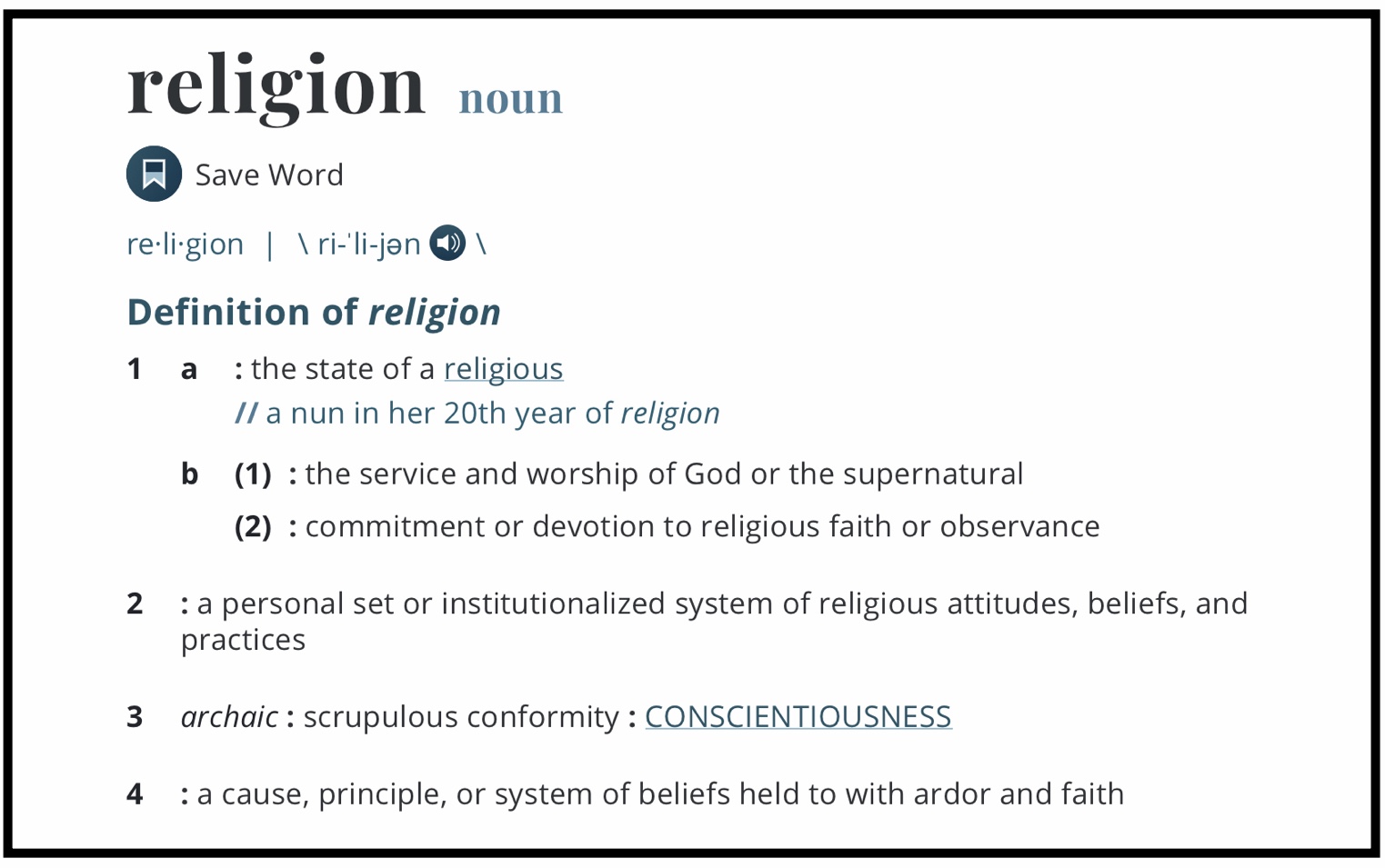
Many theists claim that atheism is a religion, but that claim is inherently a dishonest one. As evidence, they often refer to the following Merriam-Webster definition of religion.
re•li•gion \ri-ˈli-jən\ noun
[Middle English religioun, from Anglo-French religiun, Latin religion-, religio supernatural constraint, sanction, religious practice, perhaps from religare to restrain, tie back — more at rely] 13th century
1a: the state of a religious 〈a nun in her 20th year of religion〉
b(1): the service and worship of God or the supernatural
(2): commitment or devotion to religious faith or observance
2: a personal set or institutionalized system of religious attitudes, beliefs, and practices
4: a cause, principle, or system of beliefs held to with ardor and faith
They acknowledge that definitions 1 and 2 don’t apply to atheists, and they focus on definition 4. But let’s dissect the definition.
Is atheism a cause, principle, or system of beliefs? One can certainly define it as a cause for some, as well as a principle. It is not a system of beliefs, however. “Atheism” only defines one thing that the person does NOT believe in. It says nothing as to what the atheist DOES believe. But given this was a statement of “or”, this part of the definition is applicable to atheists.
Is the disbelief in god(s) held to with ardor and faith? Well that depends on the person. Many atheists give little thought to their atheism, just as they give little thought to their disbelief in Santa Claus. Some (obviously including this author) give it much more thought. We argue against theism because we object to theist attempts to insert their religion into our schools, install their icons in our public spaces, and attempts to set public policy based on the musings of primitive men. So yes, there can certainly be some ardor involved. But if the atheist is arguing against theistic claims, and overreaching (noted above) by theists, that’s not the same as saying that the beliefs themselves are held with ardor or faith. As we know, many of the American founding fathers were theists, but were adamantly opposed to theocracies
Is there faith involved? Those who argue that atheism is a religion say yes, claiming that the atheists hold their beliefs with blind faith. But that’s only remotely true for SOME atheists. Atheism is commonly subdivided into two forms: Gnostic Atheism, where individuals claim to KNOW there are no gods, and Agnostic Atheism, where individuals argue that we cannot know for certain whether god(s) exist, but who choose to disbelieve in god(s) due to the absence of objective evidence.
One could reasonably argue that the gnostic atheist is acting on faith, when he claims (in the absence of proof) to know there are no gods. But it’s absurd to ascribe faith to the agnostic atheist.
I’ve seen no surveys on what percent of atheists are gnostic vs agnostic. I fall into the latter group, as do the vast majority of atheists I know, or whom I’ve had discussions with on social media. It’s rare that I come across gnostic atheists. Christian apologists seem to be of the opinion that most are gnostic atheists, based on the misinterpretation of (sometimes intense) vocal opposition. But as I’ve noted, intense opposition to unsupported theistic claims, and to theist overreach is not a valid indicator of atheistic gnosticism.
So in summary, the claim that atheism is a religion is applicable, at most, to gnostic atheism, which I believe is a small subset of the atheist population.
But this brings us to the other major problem with the claim. Even if we stipulate that gnostic atheism is a religion (under definition 4), it is not a religion in the same sense that Christianity, Judaism, Islam, Hinduism, etc. are religions (under definition 1). In fact, if we go back to Merriam-Webster, we can see an enormous difference in the meanings, by looking at the examples:
Examples of religion in a Sentence
Many people turn to religion for comfort in a time of crisis.
There are many religions, such as Buddhism, Christianity, Hinduism, Islam, and Judaism.
Shinto is a religion that is unique to Japan.
Hockey is a religion in Canada.
Politics are a religion to him.
Where I live, high school football is religion.
Food is religion in this house.
Those who argue that atheism is a religion, are using it in the same sense that hockey, politics, football and food are religions, NOT in the same sense as Christianity, Hinduism, Islam, Judaism, and Shinto. The use of the word “religion” under definition 4, arose as a metaphorical term, rather than in any literal sense.
It’s both logically and semantically wrong to claim that theistic religions and atheism are qualitatively the same, when one isn’t using the same definition of the word. Equating the literal religions of Christianity, Judaism, etc. with the metaphorical religions of atheism, hockey, etc. is patently absurd. And it’s dishonest.






 UnApologetics